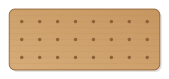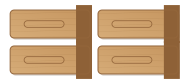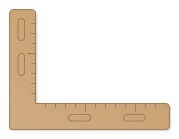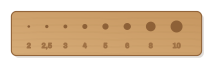
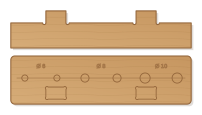
Hardwood dowel jig with fence: two guide holes each for 6, 8 and 10 mm, 32 mm apart, centred on the board edge. The edge distance adapts to the board thickness.
- Size
- 196 × 109 mm, 12 mm thick
- Material
- Hardwood (beech, oak)
- Difficulty
- Beginner
- Milling time
- approx. 18 min
- Bits
- V-bit 60°, End mill Ø 3.175 mm
- Customise
- Size, text and details adjustable with sliders
- With a laser
- too thick for a diode laser (12 mm)
Try it without an account · carve with Chrome or Edge · no installation
Build instructions
Materials and accessories
| Qty | Part |
|---|---|
| 1 | Wood glue (water-resistant D3) |
Also: sandpaper (grit 120 and 240), a utility knife or fine saw and, for joints, a rubber mallet.
Carving and finishing
- Clamp the workpiece flat on the spoilboard or secure it with double-sided tape, and set the origin as shown in the carving assistant.
- Mill the mortises and guide holes, engrave diameters and centre line, then cut out plate and fence.
- Free the parts at the holding tabs with a utility knife or fine saw and sand the tab remains flush.
- Before gluing, dry-fit everything. If a joint is too tight, increase the clearance by 0.05 mm and carve the part again; if it wobbles, reduce it.
Assembly and final touches
- Glue the fence with its tenons into the plate from below; it must sit exactly square. Sand the tenons flush on top.
- Set the edge distance to half the thickness of the boards you are joining (9 mm for 18 mm). Put the jig with its fence against the edge, hold it and drill with the matching wood bit and a depth stop. For many holes press in metal drill bushings.
How to carve this template
- OpenOpen the template in the app and adjust size and text if you like.
- CheckLook at it in 3D, check run time and warnings.
- Set upThe carve wizard guides you through material, clamping, bit and zero point.
- CarvePress start; the app drives your Grbl router directly over USB.